Binary Options for Beginners
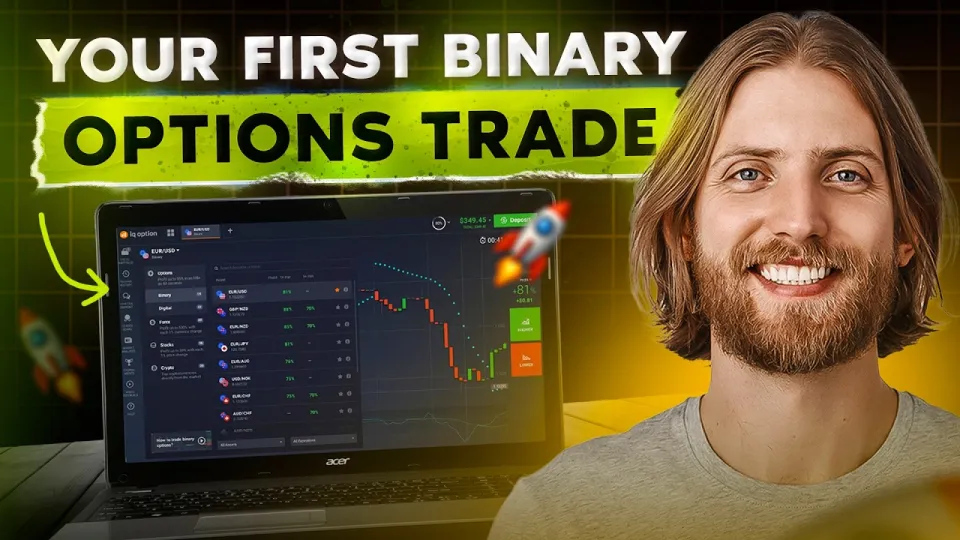
· based on the channel Binary options tutorial for beginners
A binary option is a fixed-stake contract in which you predict whether an asset's price will be higher or lower at a set expiry time; if you are right you get a fixed payout (usually 70–95% of the stake), and if you are wrong you lose the stake itself. Beginners should start with a demo account on a regulated-style platform such as Quotex, fix a risk limit of 1–2% per trade, and only move to real money after a strategy shows a positive result over at least 100 trades.
What a binary option actually is
A binary option has only two outcomes, which is where the name comes from. You choose an asset (currency pair, stock, index or crypto), a stake, an expiry (from 60 seconds up to a day or more) and a direction: Call if you expect the price to finish above the entry level, Put if you expect it below. At expiry the platform compares the price with the strike and pays out or closes the trade at zero.
The payout is fixed at entry, so the size of the win does not depend on how far the price moves — a one-pip win pays the same as a fifty-pip win. That single feature defines the whole risk model: the loss is always 100% of the stake, and the profit is always less than 100%. Everything else in binary options trading is about managing that asymmetry.
The math you must accept before trading
Because a losing trade costs the full stake and a winning trade pays only a fraction of it, the break-even win rate is higher than 50%. At a 70% payout you need 1 / (1 + 0.70) ≈ 58.8% accuracy just to stay flat; at 80% payout the threshold is about 55.6%; at 90% it is roughly 52.6%. A strategy that wins six trades out of ten is not profitable at a 70% payout — it is barely breaking even after the spread of losses.
This is why position sizing matters more than the entry signal. With 1% of the account risked per trade, ten consecutive losses cost about 9.6% of the balance; with 10% risked per trade, the same streak wipes out 65%. Beginners who blow up accounts almost always do it through stake size, not through bad analysis.
A step-by-step start for beginners
- Open a demo account first. Quotex, Pocket Option and Binarium all offer demo balances, and the minimum real deposit on these platforms is typically around $10–$50 with trade sizes from $1.
- Pick one asset and one expiry. A single currency pair such as EUR/USD on 5-minute expiries removes most of the variables while you learn how price behaves.
- Learn one signal. Support and resistance bounces, trend-following pullbacks or candlestick patterns — one setup, tested repeatedly, beats five half-understood indicators.
- Log every trade. Entry time, direction, expiry, stake, result and the reason for entry. After 100 trades the journal tells you whether the edge is real.
- Set a hard risk rule. No more than 1–2% of the balance per trade and a daily stop of three to five losses.
- Go live small. Keep stakes at the minimum until the demo results repeat on real money, where slippage and emotion change the picture.
Choosing a binary options platform
The three platforms recommended in the video are Quotex, Pocket Option and Binarium. They differ in interface, asset list and payout levels rather than in the core mechanics, so the practical approach is to register on one, test the demo, and compare the payout on the asset you actually trade.
Check four things before depositing: the payout percentage on your chosen pair, the minimum stake, the minimum deposit and withdrawal terms, and whether the platform offers a demo mode without verification. A payout difference of five percentage points changes the break-even win rate by about two points, which matters more than any chart colour scheme.
Questions beginners ask most
The recurring doubts under beginner tutorials are always the same three. First, whether a VPN is needed: viewers in restricted regions ask how to reach the platforms at all, and the video description points to Nord VPN for that purpose. Second, whether trading signals or a "manual" can replace practice — no, because the same signal executed with different stake sizes produces completely different results. Third, how much money is enough to start: on these platforms a $10–$50 deposit with $1 stakes gives 10–50 trades, which is enough to test a setup but not enough to expect income.
Another frequent question is about time. Short expiries of 60 seconds feel easier because the outcome arrives fast, but they leave no room for analysis and amplify the effect of the payout asymmetry. Most beginners do better on 5–15 minute expiries, where a chart pattern has time to play out.
All links from the video
- Quotex registration: https://dakaklik.com/_quotex?creative_id=WzzpYsjS3ps
- Pocket Option registration: https://dakaklik.com/_PocketOption?creative_id=WzzpYsjS3ps
- Binarium registration: https://dakaklik.com/_Binarium?creative_id=WzzpYsjS3ps
- Nord VPN: https://dakatop.link/Nord_us?creative_id=WzzpYsjS3ps
Conclusion
Binary options are a simple product with an unforgiving payout structure: fixed gains below 100%, losses at exactly 100%, and a break-even win rate close to 59% at a typical 70% payout. Starting correctly means a demo account, one asset, one setup, a journal and a 1–2% risk cap — in that order. The video breakdown on the channel Binary options tutorial for beginners walks through the same starting sequence and links to the three platforms above. If you are ready to test a demo, begin with Quotex via this link and keep the first live stakes at the minimum until the numbers justify more.
Key takeaways
- A binary option is a fixed-stake contract: you predict whether the price will be higher or lower at expiry and either receive a fixed payout (typically 70–95%) or lose the entire stake.
- Three platforms are recommended as starting points: Quotex, Pocket Option and Binarium, all accessible via the links in the video description.
- Risk per trade for a beginner should stay at 1–2% of the account; with a 70% payout you need roughly 59% accuracy to break even.
- Minimum deposits on these platforms usually start around $10, and trade sizes can be as low as $1, which allows testing a strategy on a demo account first.
- A VPN such as Nord VPN is suggested in the video description for accessing platforms where local restrictions apply.
Questions & answers
How much money do I need to start trading binary options?
On the platforms covered in the video, the minimum deposit is usually around $10–$50 and the minimum stake is $1. That is enough to place 10–50 test trades, so treat the first deposit as tuition rather than capital. A larger balance only makes sense once your journal shows a win rate above the break-even level for your payout.
Do I need a VPN to access binary options platforms?
Viewers in restricted regions often cannot open the sites directly, which is why the video description includes a Nord VPN link. A VPN changes how you reach the platform, not the trading mechanics or the risk. Check the legal status of binary options in your own jurisdiction before depositing anything.
What win rate do I need to be profitable?
It depends on the payout. At 70% you need about 58.8% winning trades to break even, at 80% about 55.6%, and at 90% about 52.6%. Anything below that threshold means the account slowly drains even with a decent-looking strategy, so track your real win rate over at least 100 trades.
Are short 60-second expiries better for beginners?
No. One-minute expiries leave no time to analyse the chart and turn trading into a coin flip with a negative expected value because of the payout structure. Expiries of 5–15 minutes give a pattern room to develop and make journaling and review far more useful while you learn.
Source: Binary Options | Binary Options Tutorial for Beginners | Where Should You Start? · Markdown version