Forex Trading for Beginners
Need articles like this for your video? They help promote it on YouTube and Google — order them in the Telegram bot @sat_sit_bot. Articles with your video embedded are written and posted by the bot itself — on popular topical sites (no ads). Your first 50 articles are free.
· based on the channel Matt Donlevey - Photon Trading
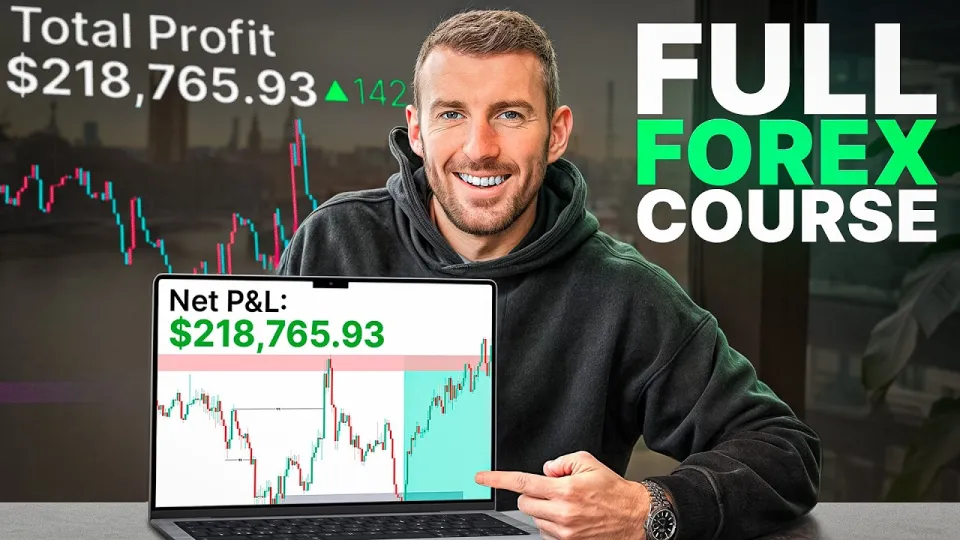
Forex trading is the buying and selling of currency pairs on the foreign exchange market, the largest and most liquid financial market in the world, where daily turnover exceeds $7 trillion. For beginners, it is a speculative activity that requires a clear strategy, strict risk management, and realistic expectations—most retail traders lose money because they skip the foundational work. Matt Donlevey's Photon Trading guide offers a free structured course and cheatsheets that cover everything from market microstructure to a complete trading plan; you can access it here: Free Photon Trading Course + Cheatsheets.
What Forex Trading Actually Involves
Forex trading means speculating on the exchange rate between two currencies. Unlike stocks, there is no central exchange; trading happens over-the-counter (OTC) through a network of banks, brokers, and electronic platforms. The most traded pair is EUR/USD, followed by USD/JPY and GBP/USD. Retail traders usually access the market through a broker that provides leverage, typically 30:1 in the EU and UK, and up to 50:1 in the US for major pairs. Leverage amplifies both gains and losses, so position sizing is critical. The cost of trading is embedded in the spread—the difference between the bid (sell) and ask (buy) price—and sometimes in commissions. Understanding these mechanics is the first step; without them, any strategy is built on sand.
Why Technical Analysis Alone Falls Short
Technical analysis—chart patterns, trendlines, and indicators—is a tool, not a reason for price to move. Price moves because of order flow: the constant interaction of buyers and sellers in an auction market. Geometric shapes like triangles or head-and-shoulders do not explain why a level holds or breaks; they only describe what has already happened. To build a strategy with real logic, you need to understand market microstructure: the order book, bid-ask spread, liquidity, and how large orders are absorbed. Auction market theory suggests that price seeks areas of high liquidity and fair value, and order flow reveals the imbalance between aggressive buyers and sellers. When you combine structure with order flow, you move from guessing to probabilistic thinking.
The Core Components of a Forex Trading Strategy
A robust forex strategy is a set of rules that defines four things: market structure, entry trigger, risk management, and exit. Market structure is the sequence of higher highs and higher lows (uptrend) or lower highs and lower lows (downtrend). Photon Trading emphasizes three types of structure—trending, ranging, and transitional—and teaches you to identify premium and discount zones within a range. Entries are taken at key supply and demand levels, often after a liquidity sweep. Risk management specifies the percentage of capital risked per trade (commonly 0.5–1%) and the risk-reward ratio (aim for at least 1:2). Exits are based on the next opposing structure point or a trailing stop. Without written rules, you are gambling; with them, you have a testable edge.
How to Manage Risk and Money in Forex
Money management determines whether you survive long enough to profit. The golden rule: never risk more than 1% of your account on a single trade. If you have a $5,000 account, your maximum loss per trade is $50. This allows you to withstand a losing streak of 10 trades and still keep 90% of your capital. Position size is calculated by dividing the dollar risk by the stop-loss distance in pips, adjusted for pip value. For example, if you risk $50 and your stop is 20 pips away on EUR/USD (pip value $10 per standard lot), you trade 0.25 lots. Leverage should be used conservatively—high leverage is not a license to take oversized positions. Also, set a daily or weekly loss limit (e.g., 3% of account) to prevent revenge trading. These rules are mechanical, not emotional.
Building a Trade Plan and Journaling
A trade plan is a written document that specifies your market, timeframe, entry and exit criteria, risk parameters, and trading hours. It removes impulse decisions. Backtesting is the process of applying your plan to historical data to see if it would have been profitable; use at least 100 trades across different market conditions. Trade journaling records every trade—entry, exit, reason, emotion, and screenshot—so you can identify patterns in your behavior. Common mistakes include moving stop-losses, over-leveraging, and trading without a plan. Your journal will reveal these. The Photon Trading guide stresses that psychology is easier to master once you have a proven strategy; discipline follows confidence, not the other way around.
Choosing a Broker and Understanding Costs
A broker is your gateway to the forex market; regulation is non-negotiable. Choose a broker regulated by a tier-1 authority such as the FCA (UK), ASIC (Australia), or CySEC (Cyprus). Costs include the spread, commissions, and swap rates (overnight financing). For example, a spread of 1 pip on EUR/USD costs $10 per standard lot. If you trade 10 lots per month, that's $100 in spread costs alone. Some brokers charge a commission of $3–$7 per lot per side, which may be cheaper for high-volume traders. Also consider execution speed, platform stability, and customer support. Avoid brokers that promise guaranteed profits or have unclear fee structures. The right broker aligns with your strategy and risk profile.
Common Questions and Concerns from New Traders
Many beginners ask whether this material is truly free and comprehensive. The Photon Trading course is free and covers topics that other courses sell for hundreds of dollars, but it requires time and practice—watching alone is not enough. Another common concern is the pace of instruction; some viewers find it fast, so use the timestamps to revisit sections. A frequent question is how much capital is needed: you can start with $500–$1,000, but the focus should be on percentage returns, not dollar amounts. Finally, some viewers ask about trading psychology—the consensus is to first build a proven edge, then work on mental discipline. These answers reflect real viewer feedback and the core message of the guide.
Useful Links
- Free Photon Trading Course + Cheatsheets
- Photon Mentorship Program
- Free Telegram Channel
- Instagram: @photontrading
Final Thoughts
Forex trading is a skill that demands structured learning, disciplined risk management, and continuous review. Matt Donlevey's Photon Trading guide provides a systematic framework—from market microstructure to a complete trade plan—that is rare to find for free. Use the free course and cheatsheets to build your foundation, then commit to backtesting and journaling before risking real capital. Remember that most traders fail because they skip the basics; this guide gives you the basics in depth. The channel Matt Donlevey - Photon Trading is the author of this comprehensive breakdown, and it remains a valuable reference for beginners in 2026.
Key takeaways
- Forex is a decentralized over-the-counter market where currencies are traded in pairs; the bid-ask spread is the primary cost.
- Retail traders typically access leverage of 30:1 in the EU/UK and up to 50:1 in the US, which magnifies both profits and losses.
- A complete trading strategy must define market structure, entry triggers, risk per trade, and exit rules before any capital is deployed.
- Order flow and auction market theory explain short-term price movement better than geometric chart patterns alone.
- Backtesting and trade journaling are non-negotiable steps for validating an edge and maintaining discipline.
Questions & answers
Is the Photon Trading course really free?
Yes, the core course and cheatsheets are available at no cost through the link provided. The free material covers all the essential topics from market basics to a full trading plan. There is also a paid mentorship for those who want advanced guidance.
How much money do I need to start forex trading?
You can start with as little as $100 with a micro account, but a more realistic minimum for proper risk management is $500–$1,000. The key is to risk a small percentage per trade, so your account size determines your position size. Focus on percentage returns rather than dollar profits.
Why do most beginners lose money in forex?
Most beginners lose because they trade without a plan, use excessive leverage, and let emotions drive decisions. They also skip backtesting and journaling, so they never identify what works. A structured approach with strict risk management significantly improves the odds.
Is this course suitable for someone with no experience?
Yes, the guide starts from the very basics of what forex is and how the market operates. It then progresses to advanced concepts like order flow and liquidity. The timestamps allow you to navigate to the topics you need, making it accessible for complete beginners.
Source: Beginners Guide To Forex Trading In 2026 (+3 hours) · Markdown version